
Why Nigeria's Senate rarely says no
Nigeria borrowed America's system but not its calendar. What that means for who checks the president, under PDP and APC alike.
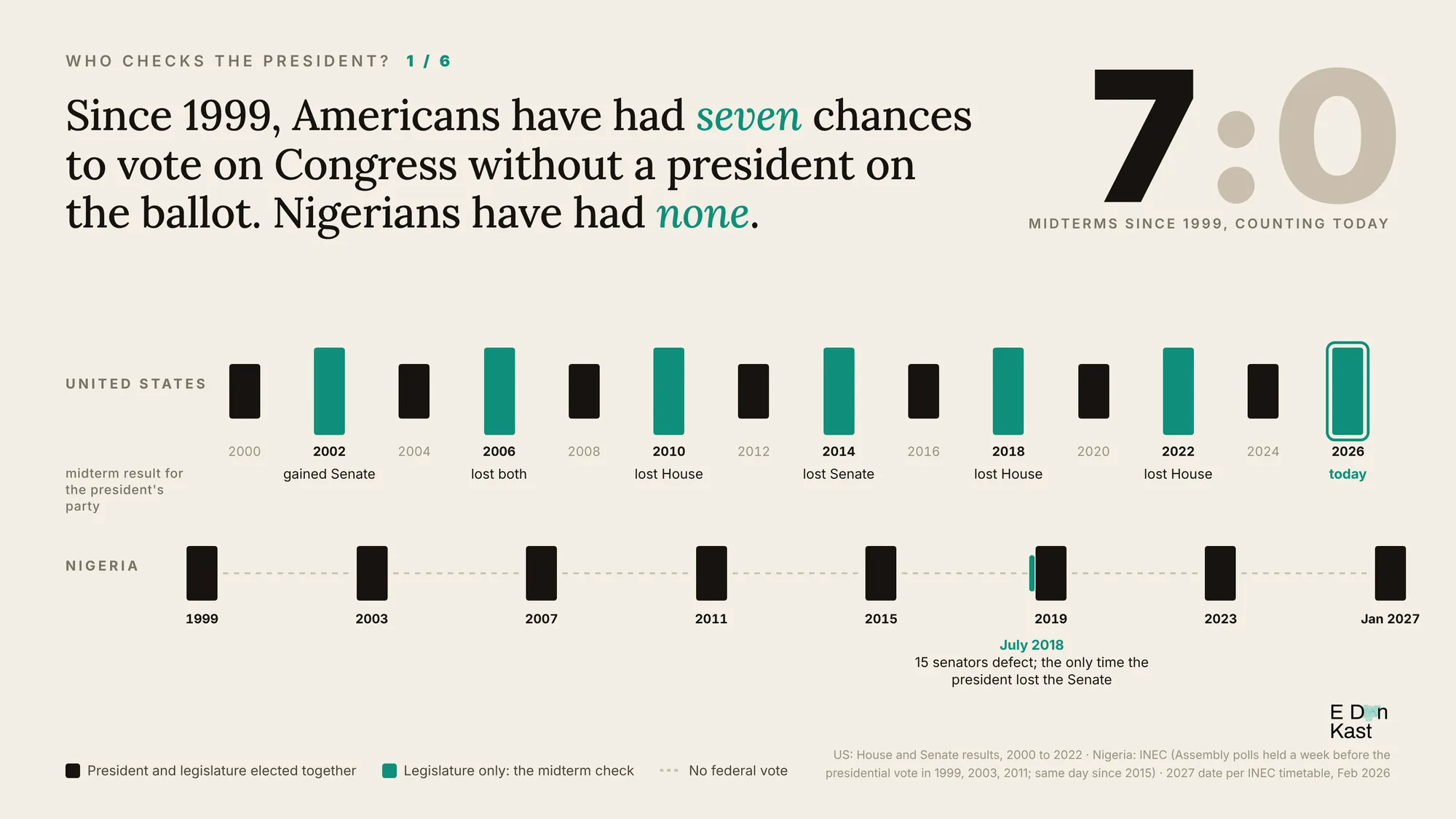
Nigeria's 1999 constitution borrowed its shape from the United States: an elected president, a two-chamber National Assembly, and a Supreme Court, each meant to hold the others in check. The design works in America partly because of timing. Every House seat is contested every two years and senators serve staggered six-year terms, so voters get to pass judgment on Congress halfway through a presidency. Since 1945 roughly six years in ten have seen at least one chamber controlled by the party opposed to the president, from Truman to Reagan to Obama to Biden. This week's midterms are that mechanism at work.
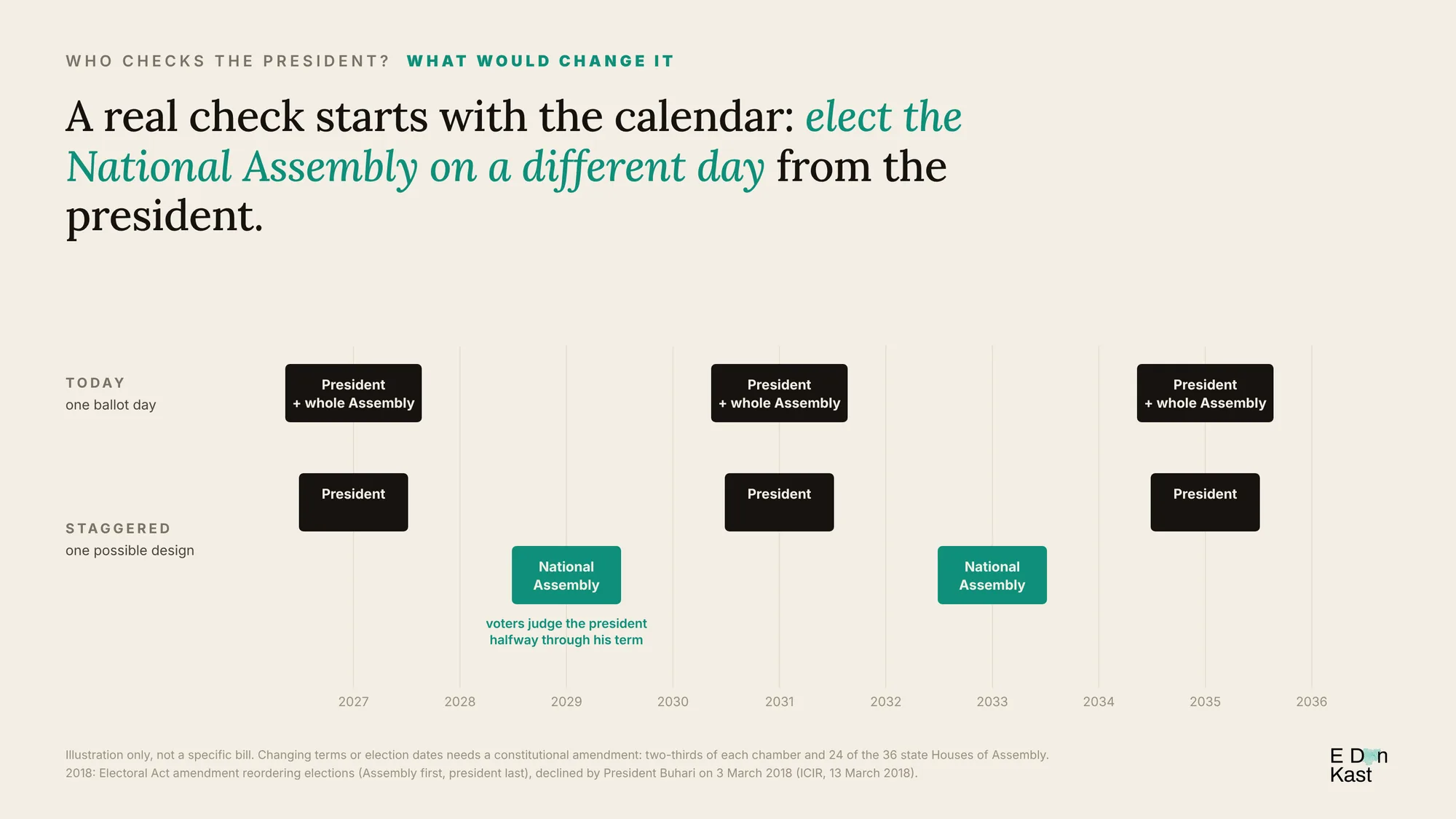
Nigeria elects almost everything at once. Under the Electoral Act 2026, the presidential and National Assembly elections hold together on 16 January 2027, with governors and state assemblies three weeks later. Lawmakers ride in on the same tide as the president and owe their tickets to the same party machinery, and there is no midterm to correct course.
The numbers, under both parties
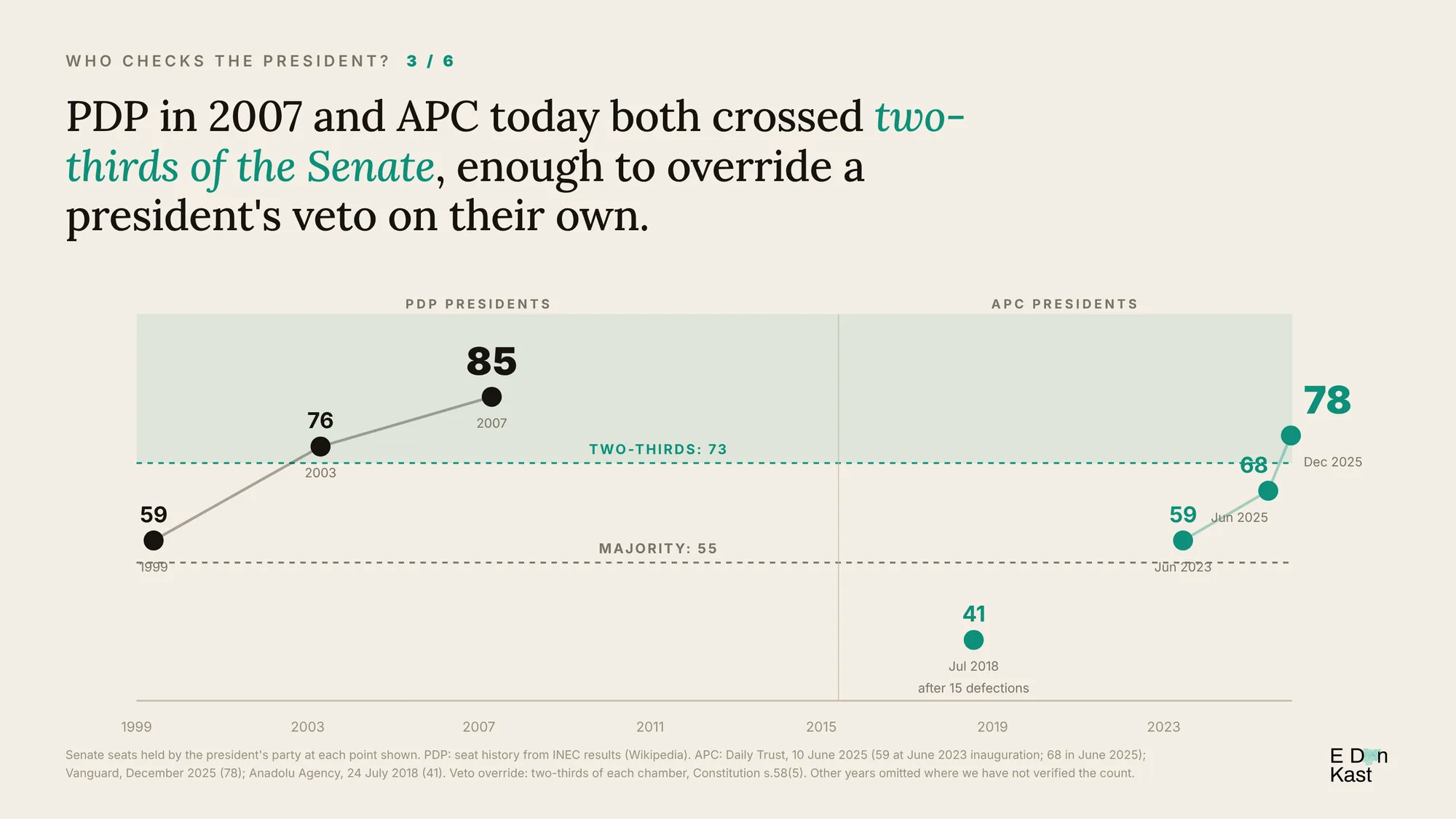
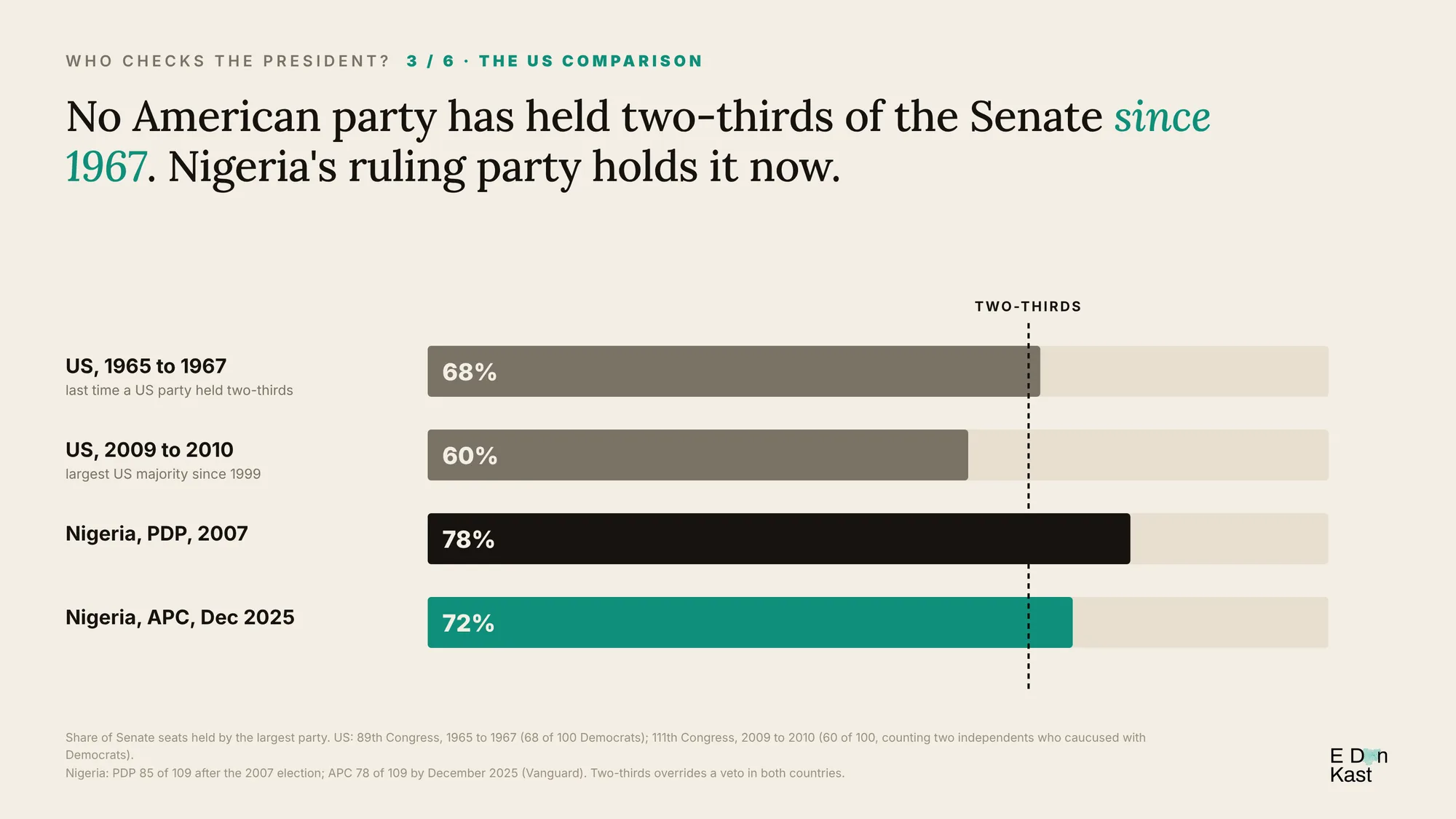
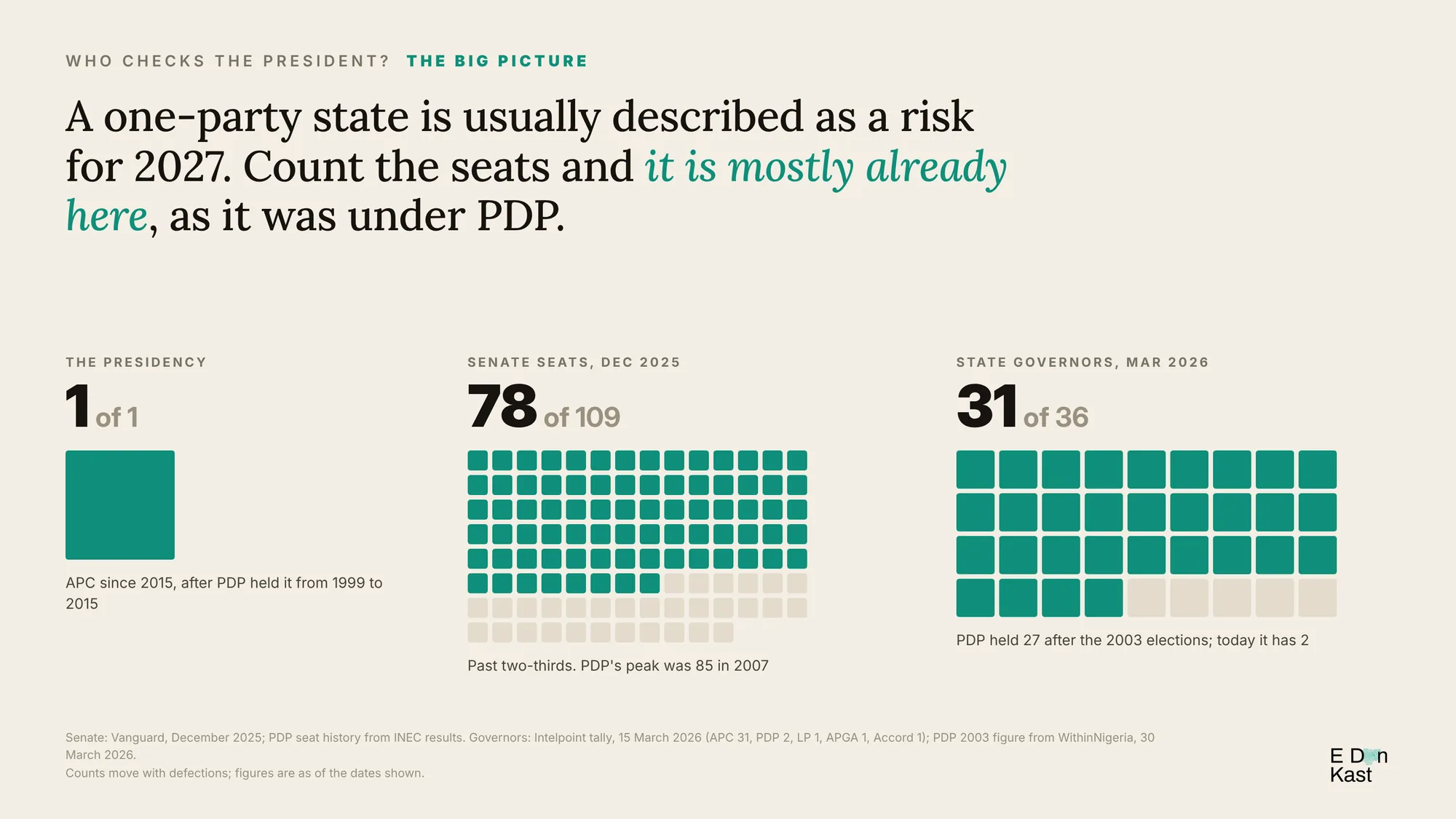
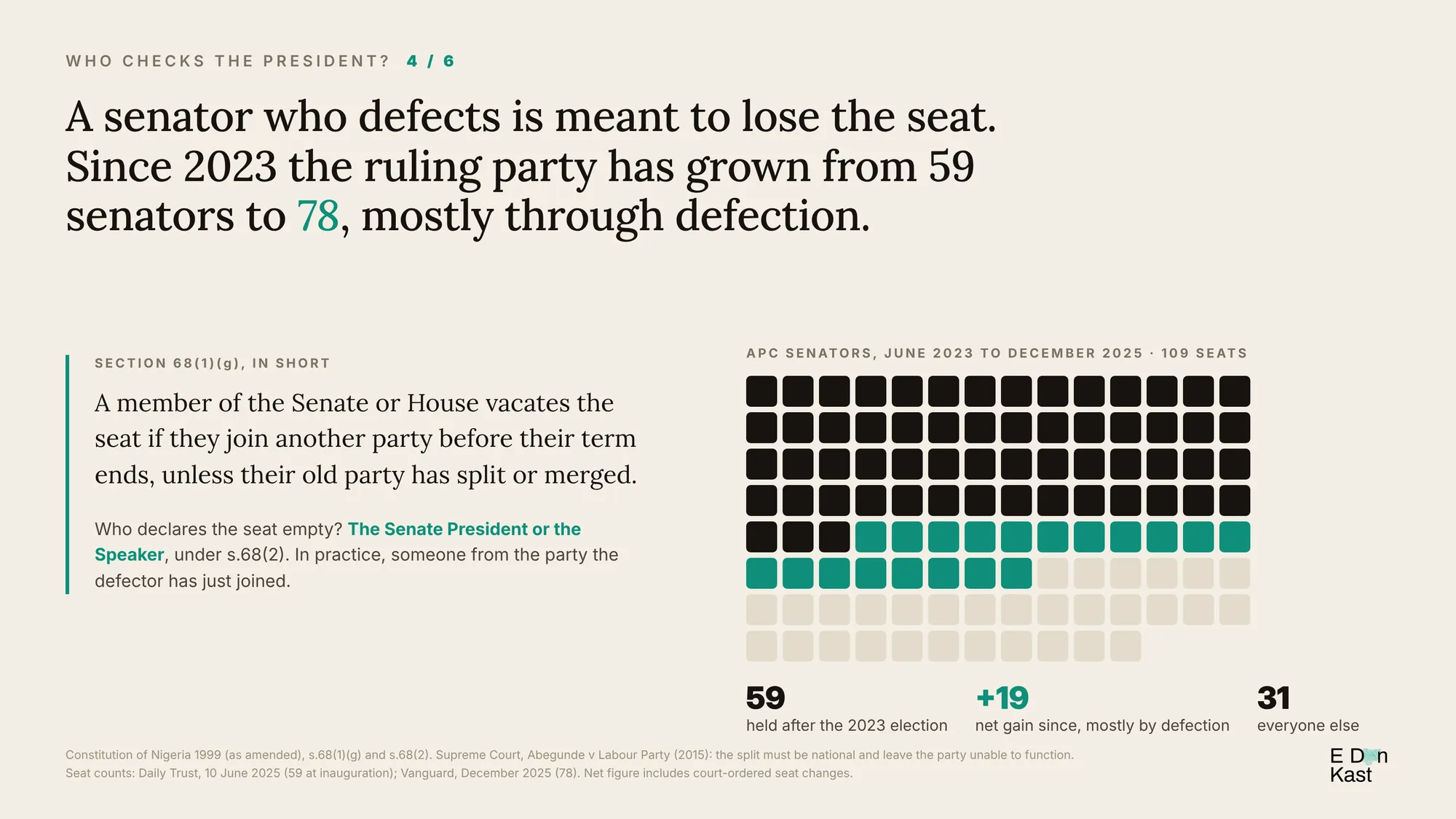
PDP took 59 of 109 Senate seats in 1999, 76 in 2003 and 85 in 2007, along with 262 of 360 House seats that year, a supermajority in both chambers. APC began the current Assembly in June 2023 with 59 senators and about 175 Reps, and by December 2025 it had 78 senators and about 240 of the 360 Reps (Vanguard). That is two-thirds of the Senate and roughly two-thirds of the House, enough to override a presidential veto (section 58) and to clear the National Assembly half of a constitutional amendment, though amendments also need 24 of the 36 state assemblies.
Why lawmakers cross over instead of resigning
Much of APC's growth came from defections rather than elections, and that points to a loophole. Section 68(1)(g) says a lawmaker who leaves the party that sponsored them loses the seat, unless the old party has divided or merged. The Supreme Court read that exception narrowly in Abegunde v Labour Party in 2015, holding that the division must be national and serious enough to leave the party unable to function. In practice, though, declaring the seat vacant falls to the Senate President or Speaker, who usually belongs to the party the defector has just joined. Changing colours keeps the seat and gets you inside the majority.
Take a bow
The result is a confirmation process that often looks ceremonial. The Senate's "take a bow" custom, which dates to 2003, lets nominees who are former lawmakers, and later many others, skip questioning; in 2019, 16 of the first 24 ministerial nominees were waved through this way. In March 2025 the Senate approved emergency rule in Rivers State by voice vote, with no recorded count, although the constitution requires two-thirds of all members, a point critics including Peter Obi and Aisha Yesufu pressed at the time.
The bow has a record. Of the 2019 nominees excused from questioning because they had sat in a legislature, Hadi Sirika went on to run the aviation ministry through the Nigeria Air project, and in 2024 the EFCC charged him, his daughter and others over an alleged ₦2.7 billion in contracts; the case is in court and he has not been convicted. Godswill Akpabio, also waved through, was summoned as Niger Delta minister in July 2020 by a House committee probing ₦81.5 billion in NDDC spending, and he is now the Senate President who presides over confirmations. In 2023 Betta Edu was confirmed with the rest of the cabinet and suspended five months later by the president who nominated her, over an alleged ₦585 million transfer of ministry funds to a private account; she has not been charged. None of this proves a tougher hearing would have caught anything. It does show what is lost when the one public hearing a minister must face is skipped.
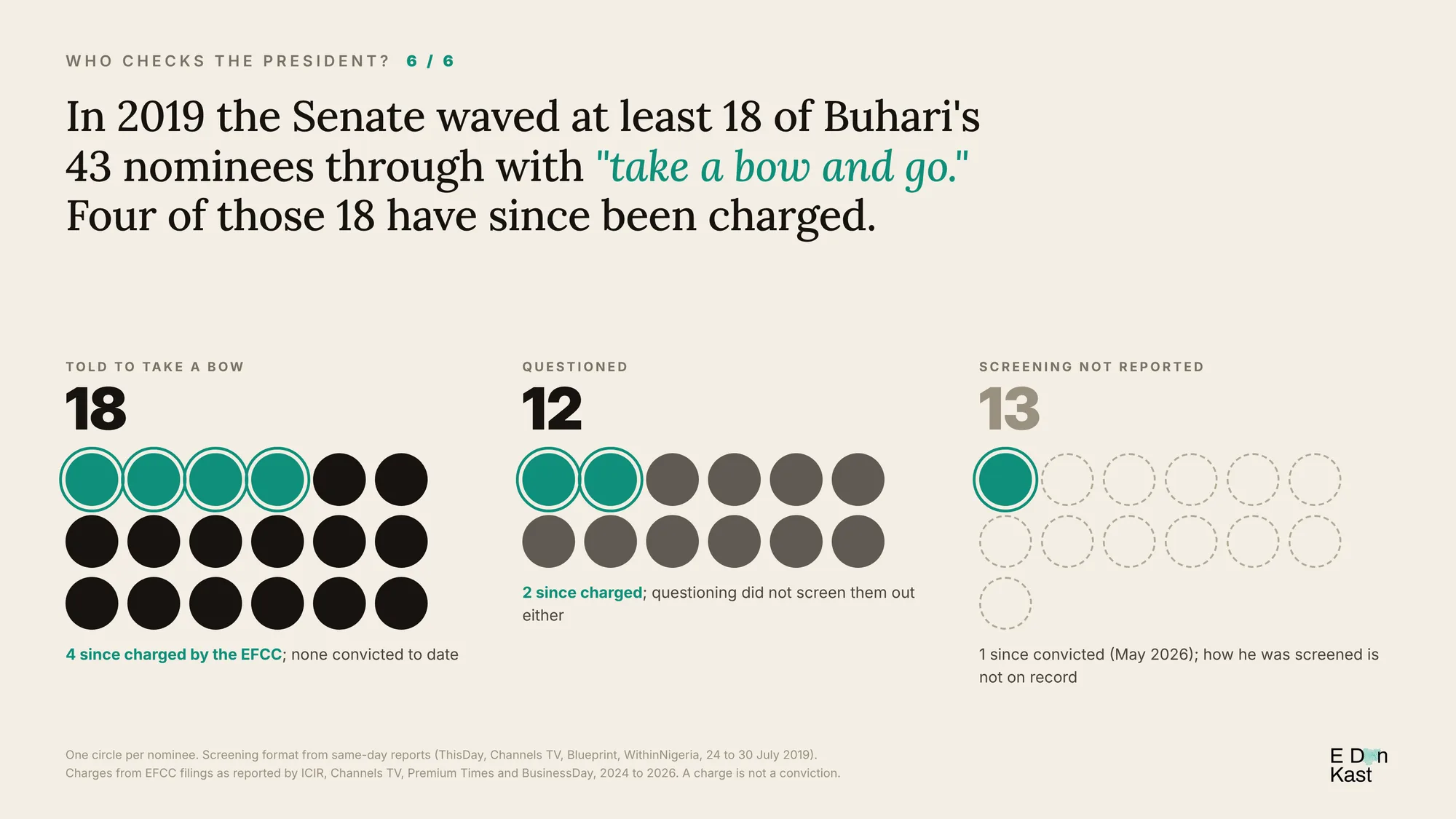
Four of those 18 have since been charged by the EFCC, and two of the 12 who were questioned; a charge is not a conviction.
When the Assembly did push back
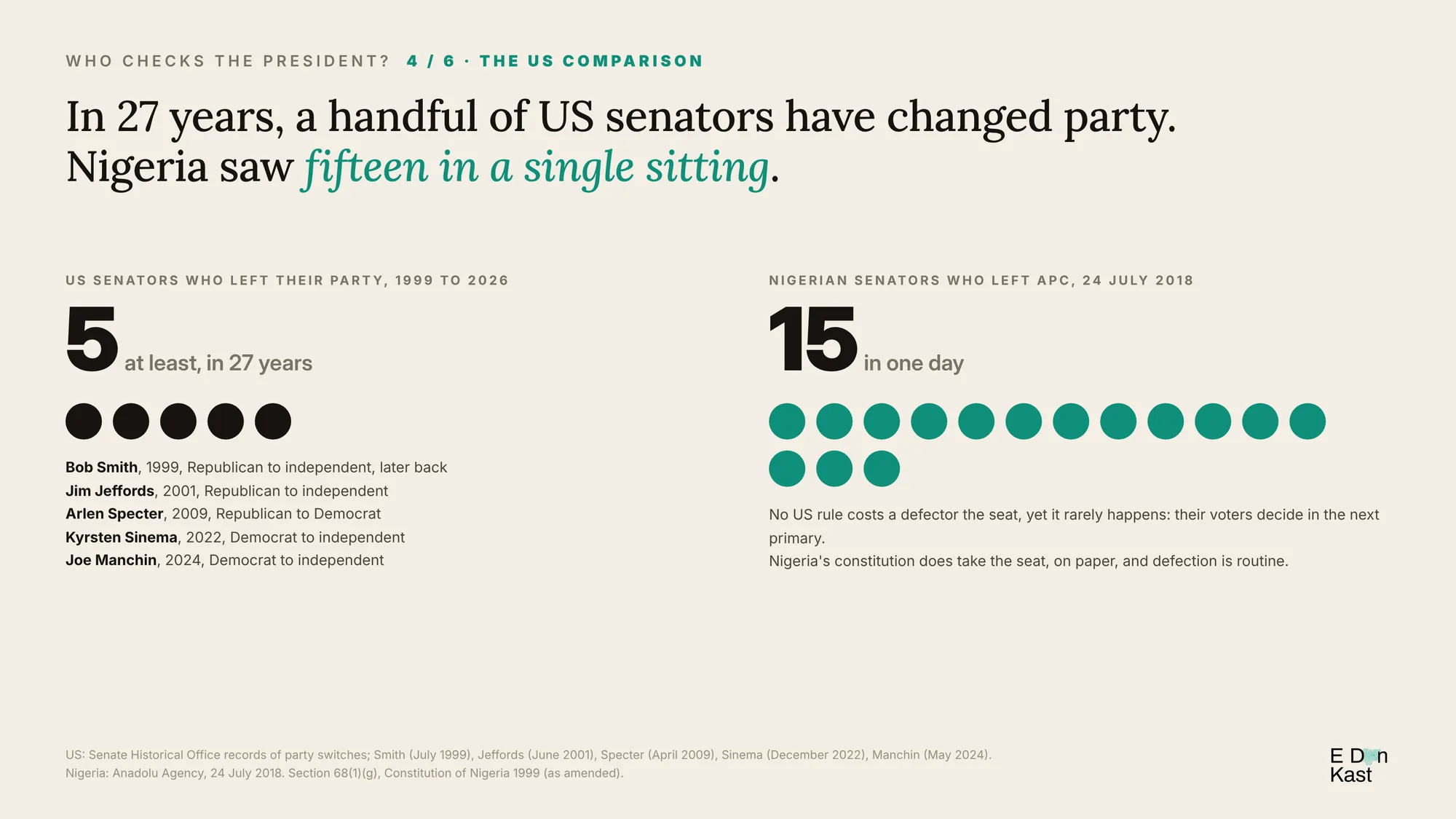
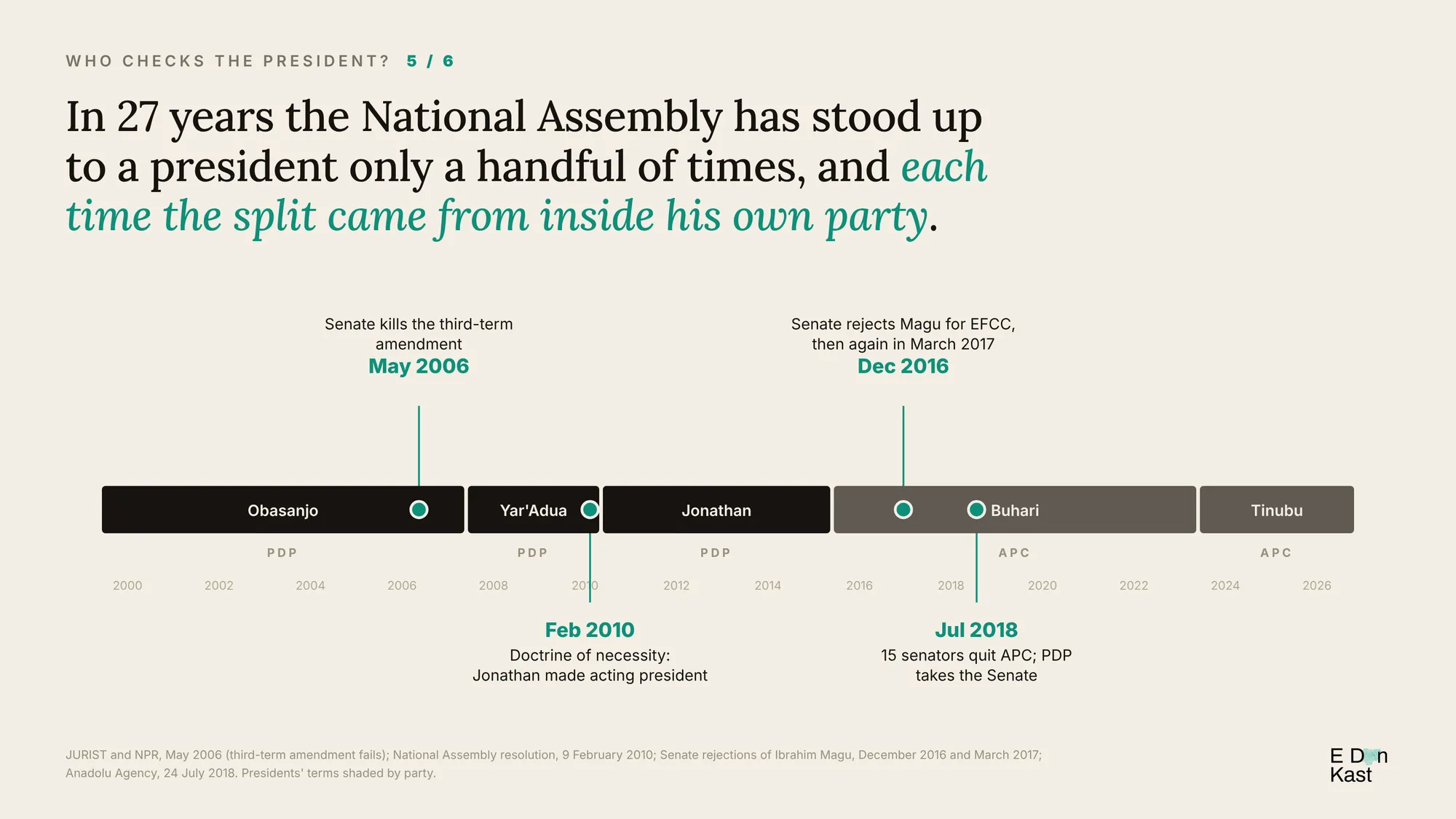
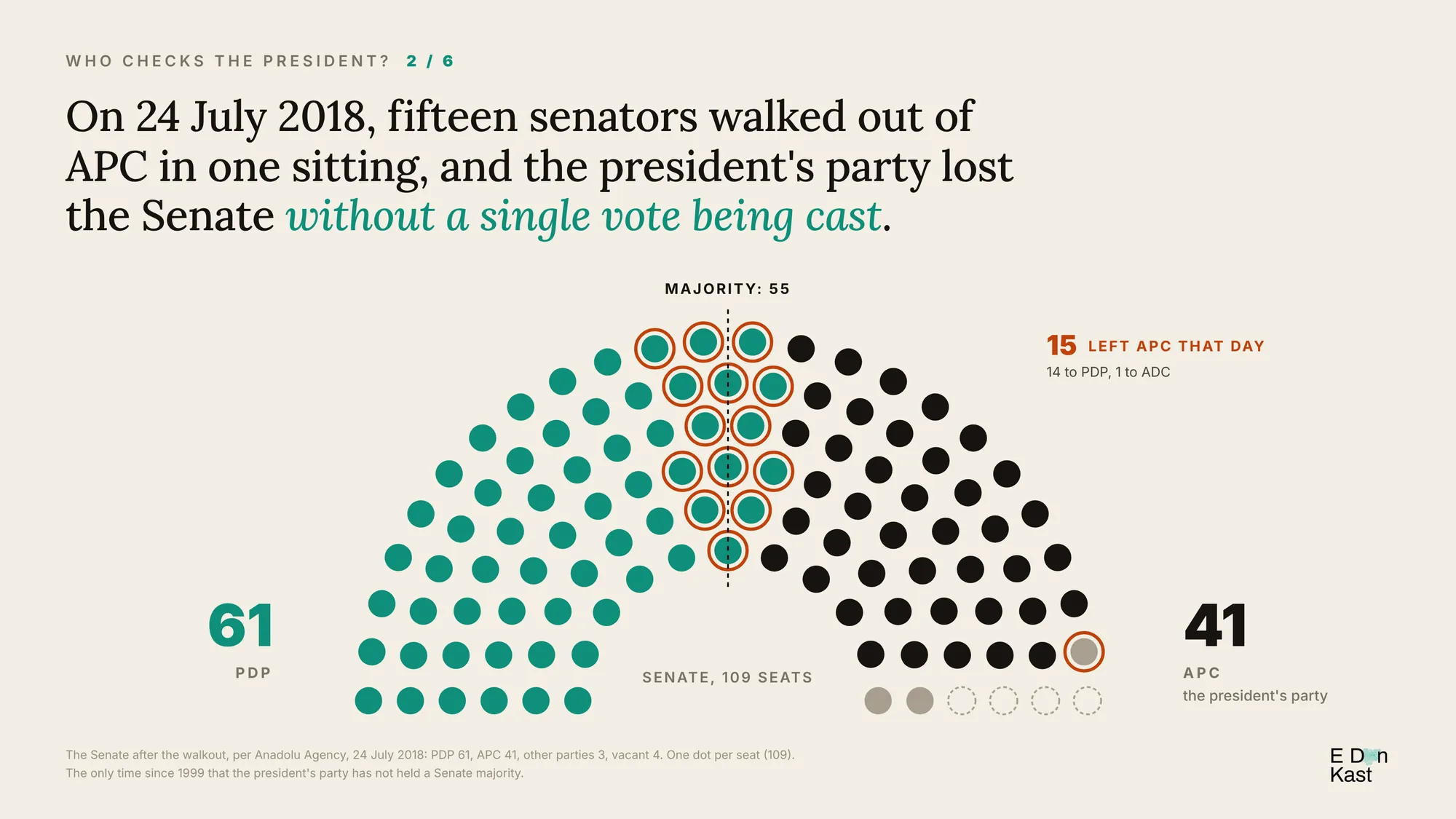
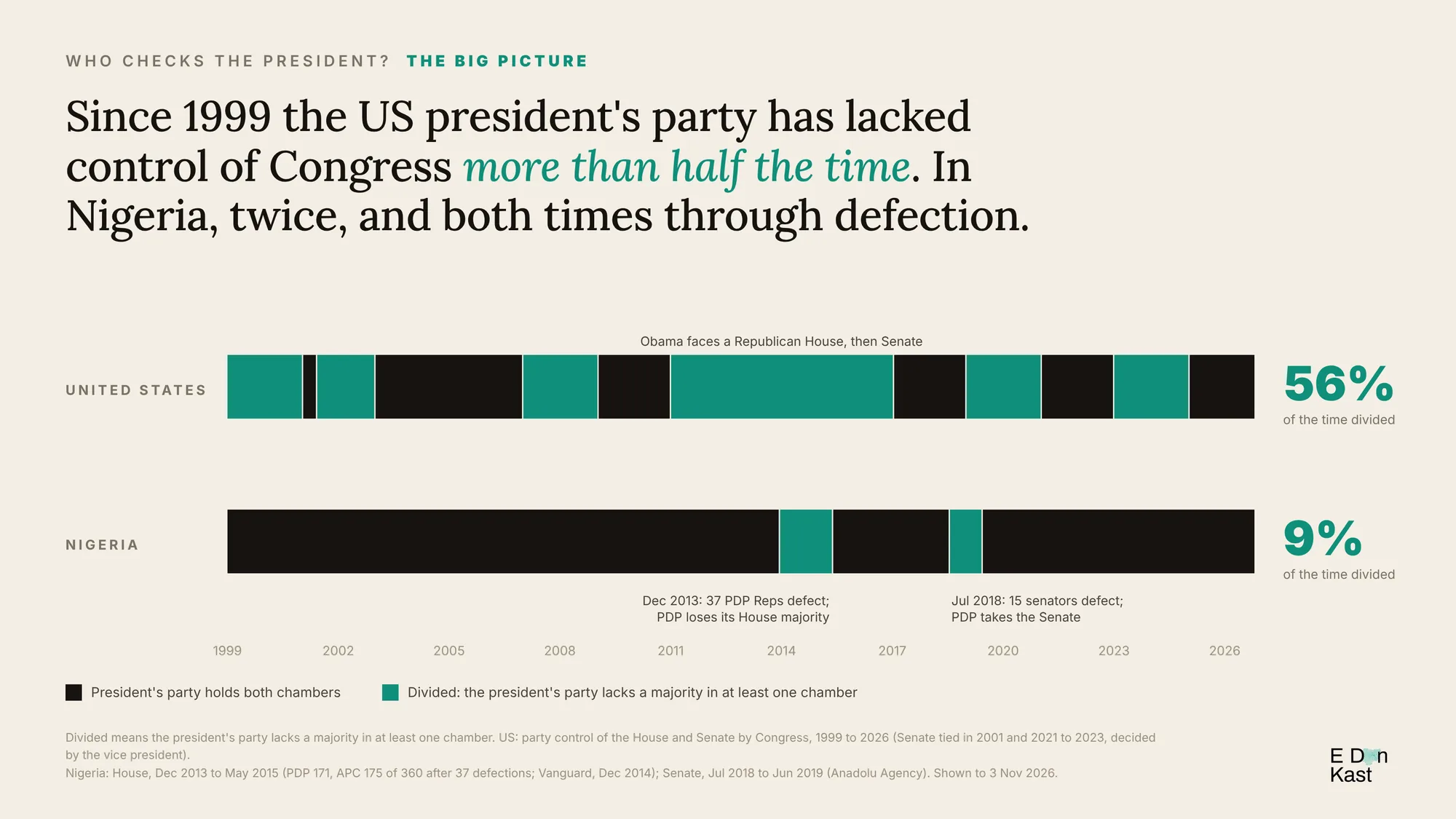
Every time it did, the trigger was a split inside the ruling party rather than an opposition majority. In May 2006 the PDP-led Senate killed the constitutional amendment that would have given Obasanjo a third term. In 2010 the National Assembly invoked the doctrine of necessity to make Goodluck Jonathan acting president while Yar'Adua was abroad and incapacitated. Under Buhari, an APC Senate twice refused to confirm Ibrahim Magu as EFCC chairman. Divided control has come only through defection. In December 2013, 37 PDP Reps crossed to the new APC, leaving PDP with 171 House seats to APC's 175 and no party with a majority until the 2015 election; the Speaker, Aminu Tambuwal, followed in October 2014. In July 2018 it ran the other way: fifteen senators left APC, briefly giving PDP a 61 to 41 lead in the Senate. Counted the American way, Nigeria's president has lacked a majority in at least one chamber about 9 percent of the time since 1999; in the United States the figure is 56 percent.
The courts
The US Supreme Court has nine justices appointed for life. Nigeria's can have up to 21, led by the Chief Justice of Nigeria, all retiring at 70. The president appoints the Chief Justice on the recommendation of the National Judicial Council, and the Senate confirms. The constitution also requires that at least three justices be learned in Islamic law and three in customary law, because appeals from Sharia and customary courts end there; former Chief Justice Tanko Muhammad, who served from 2019 to 2022, trained in Islamic law and sat on the Bauchi Sharia Court of Appeal. A Senate that rarely questions ministers is the same Senate that confirms the head of the judiciary.
What would change it
A president who wants real change will have to give up some of his own power: back a National Assembly that can stand on its own, and change the calendar so the two are no longer chosen on one wave, whether by electing the Assembly on a different date or by changing the terms. That needs a constitutional amendment, two-thirds of each chamber and 24 of the 36 state assemblies. The Assembly tried a version in 2018, amending the Electoral Act to hold legislative elections first and the presidential election last; President Buhari declined to sign it on 3 March 2018, saying the change intruded on INEC's power to organise elections.
What voters can do
Some of this needs no constitutional change at all. Voters on 16 January can judge their senator and Rep on their own record rather than the top of the ticket, and they can ask candidates one direct question: if your party wins the presidency, name one thing you would vote against.